


Ruppin 1949
Ruppin Academic Center Vision Statement
|
To be a leading, innovative, socially committed academic institution
which is preferred regionally and nationally.
|
Ruppin Academic Center Mission Statement
|
"To instill, develop and preserve academic knowledge of the highest level; to offer a broad range of academic programs awarding undergraduate and graduate degrees"
"To shape future business, social and technological leaders while emphasizing the learning experience and the value of social contribution"
|
Past and Present
Ruppin Academic Center, originally called The Ruppin School, was founded in 1949 in order to provide administrative education for Israel's agricultural settlements, kibbutzim and moshavim. The school was first authorized to open an academic program by the Council for Higher Education in 1975. That initial authorization from the Council laid the groundwork for the establishment of The School of Social Sciences and Management in 1996. In 1981, Mr. Yithak Navon, President of the State of Israel, and Education Minister Mr. Zevukun Hammer confirmed in writing that students of Ruppin's School of Economics and Management were entitled to B.A. degrees from 1979 onward. The Economics and Accounting department was established in 1993 and subsequently formally recognized by the Council for Higher Education in 1994. The undergraduate program Business Administration for Managers was founded and accredited in 1997.
During the period between 1992 and 1995 Ruppin changed its strategy. Rather than targeting potential students from moshavim and kibbutzim, the focus was switched to encompass all Israelis, with the programs offered being tailored accordingly. In 1995 the Behavioral Sciences department was founded and in 1996, as mentioned, the School of Social Sciences and Management was established, with the abovementioned departments being incorporated therein.
Today, the School of Social Sciences and Management's 2,500 registered students are divided among four undergraduate departments: Economics and Accounting, Economics and Management, Business Administration (morning and evening programs) and Behavioral Sciences. Two graduate programs were opened in 2007, with the approval of the Council for Higher Education, in the fields of MBA - Business Administration and MA - Immigration and Social Integration. It should be noted that some 21% of all business administration students in Israel study at Ruppin Academic Center.
In the late 1990's Ruppin Academic Center was faced with an economic crisis that continued through 2001. This crisis led to the redistribution of assets, to a change in the organizational system and culture and to the re-establishment of a senior academic-administrative team. With the completion of this process, the Center became a budgeted institution, financed by the Council for Higher Education. The Center embarked on its new course in 2002, led by a new and invigorated academic and administrative team and supported by government financing.
The School of Engineering began its operations in the 1995/1996 academic year as a four-year European engineering program within the framework of a branch of Coventry University, in response to the needs of the Israeli economy and an understanding of global occurrences. The program was conducted in English, integrating a team of lecturers from England with a team of local lecturers. Industrial Engineering was the first program to be opened, followed a year later by programs in Electrical and Electronic Engineering and Computer Engineering.
During the course of its operation, the school gained a favorable reputation both in the Israeli market and within the academic community thanks to the high academic level of its programs and to its hundreds of graduates, who were accredited by both the Registrar of Engineers in Israel and in Britain. All graduates were hired by leading Israeli companies and plants.
It was decided to change the School of Engineering's mode of operation for the 2000/2001 academic year, turning it into an Israeli institution, with those programs awarding degrees recognized by the Council for Higher Education.
In January 2004, the school was authorized to award B.Tech degrees in three fields: Industrial Engineering, Electrical and Electronic Engineering and Computer Engineering. From 2005 onward the school was authorized to award B.Sc. degrees in those fields. In 2007, the Council for Higher Education approved the opening of a program in Medical Engineering.
Ruppin Academic Center's School of Marine Sciences was founded in 1997 as "The Israel Marine College", under the academic patronage of The Hebrew University of Jerusalem. Up to 2003, B.Sc. degrees in Marine Sciences were awarded to graduates of the college by the Hebrew University.
The Israel Marine College was founded by Mr. Rani Idan (the current mayor of Emek Hefer), Prof. Dan Wolf (deceased) (former vice president of the Technion Israel Institute of Technology) and Prof. Micha Spira (a professor of neurobiology at the Hebrew University of Jerusalem). An association made up of senior academic and military marine issues experts helped to raise funds and guide the objectives of the Israel Marine College.
The unique and relatively small scope of activity at the Marine College rendered it necessary to merge with a larger, well established academic framework. Thus, in 2003, in accordance with a decision made by the Council for Higher Education, The Israel Marine College joined Ruppin Academic College and became the Center's third school, the School of Marine Sciences.
The School of Marine Sciences is situated on a separate campus on the Michmoret shore. The school awards B.Sc. degrees in Marine Environmental Studies and is currently preparing to offer an additional degree in Marine Biotechnology.
In addition, plans for the construction of a new building on the Michmoret Campus, which will provide modern, innovative infrastructure for a variety of existing and future study programs in the marine field, are currently being completed.
Ruppin Present and Future
Many diverse administrative and professional academic degrees have developed at the Academic Center from its inception through today. In addition to the School of Social Sciences and Management, the Center operates schools of engineering and marine sciences, with 11 academic departments awarding undergraduate and graduate degrees and a combined total of some 4,500 students.
Alongside studies in the departments, the Academic Center encourages research and various academic activities, among them the establishment of The Institute for Immigration and Social Integration, holding academic seminars and conferences on a variety of topics throughout the course of the year and the operation of a research authority for the empowerment and furthering of the academic faculty. Within the framework of the upcoming five-year plan additional graduate programs, such as logistics and marine systems management, psychology and marine biotechnology will be developed alongside unique undergraduate degrees in the realms of sociology, computer science and life sciences.
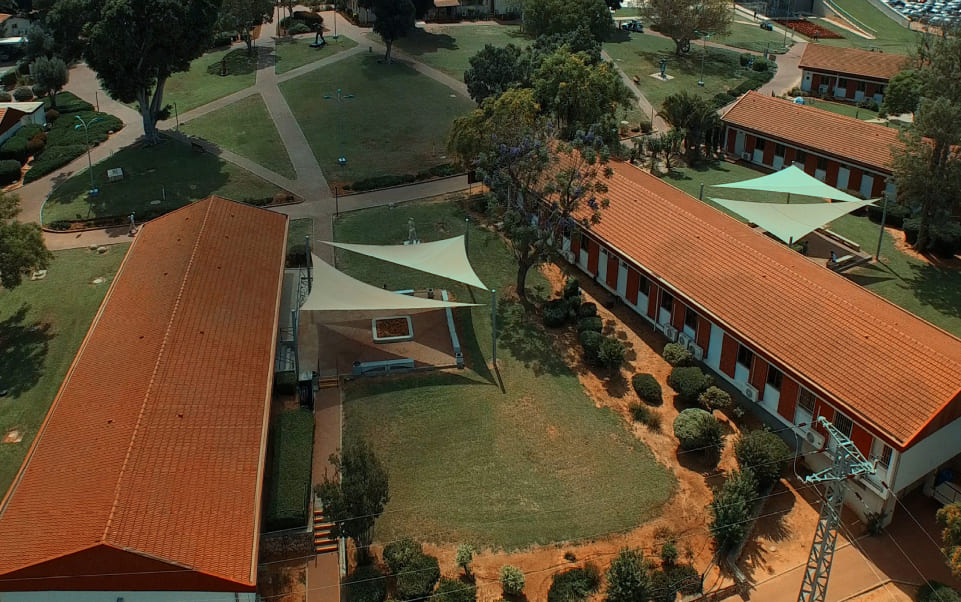
Routine academic training is not sufficient for the Ruppin Academic Center. Rather, the Center strives to cultivate a new generation of leaders who possess moral conscience and environmental awareness. As such, the Center has raised two central banners - the environment and social involvement. Ruppin Academic Center's green campus is part of a world view that includes social involvement for the benefit of the community and of the environment in which we live. The Institute for Immigration and Social Integration, which was founded in 2005, works to promote teaching and research in the field of immigration.
"Expanding Horizons" is not just a slogan, rather it is Ruppin's "creed". At Ruppin we look ahead and believe in innovation as we search for educational challenges and strive for excellence in research and learning.